

Background
Indigenous Peoples across the Asia-Pacific region remain systematically excluded from decision-making, financing mechanisms, and reporting processes related to the 2030 Agenda for Sustainable Development. Despite their vital contributions to climate resilience, biodiversity conservation, and cultural preservation, their voices are often marginalized in Voluntary National Reviews (VNRs) and Voluntary Local Reviews (VLRs) - the very processes meant to track progress on the Sustainable Development Goals (SDGs).
This exclusion undermines the principle of “leaving no one behind.” Indigenous Peoples’ knowledge systems, community-driven monitoring, and localized approaches to sustainability offer unique pathways to achieving the SDGs. Yet, without direct partnerships, direct access to financing, and recognition of their right to self-determination, these contributions remain undervalued and underutilized.
Indigenous Peoples’ community-driven monitoring, data gathering, and analysis, including Community-Based Monitoring and Information Systems (CBMIS), the Indigenous Navigator, and other Indigenous-led initiatives - offer robust, culturally grounded evidence that should be recognized as official data in national and local SDG reporting. Similarly, citizen-generated data provides critical insights into lived realities and must be integrated into SDG monitoring frameworks to complement state-led statistics.
Anchoring VNRs and VLRs in international human rights standards, such as the UN Declaration on the Rights of Indigenous Peoples (UNDRIP) and treaty body recommendations - ensures that states uphold their obligations. Indigenous-led monitoring initiatives, including community-based monitoring and information systems (CBMIS) and the Indigenous Navigator, demonstrate how ethnicity-disaggregated data and Indigenous methodologies can enrich national and local reporting, strengthen accountability, and foster inclusive governance.
This side event directly contributes to SDG 17: Partnerships for the Goals by advancing inclusive, rights-based partnerships and equitable resource mobilization. Target 17.17: Promotes effective collaboration between states and Indigenous Peoples through formalized, direct partnerships. Target 17.3: Advocates for direct access to financing for Indigenous-led initiatives, ensuring resources reach communities at the forefront of sustainable change. Target 17.18: Calls for improved capacity to produce high-quality, timely, and reliable data disaggregated by ethnicity, and recognition of Indigenous-led and citizen-generated data as official sources.
This side event also underscores that achieving the 2030 Agenda requires transformative partnerships built on respect, equity, and recognition of Indigenous Peoples’ rights. By centering Indigenous-led data initiatives, citizen-generated data, direct financing, and self-determination in VNRs, states and stakeholders can move from rhetoric to action, ensuring that Indigenous Peoples are not only included but are leading the way in building sustainable, resilient futures.
Objectives
- Promote recognition of Indigenous-led data initiatives as official sources for SDG monitoring and reporting.
- Advance inclusion of citizen-generated data in assessing SDG implementation, ensuring diverse realities are captured.
- Highlight Indigenous Peoples’ exclusion from VNRs, VLRs, and financing mechanisms, and propose pathways for systemic change.
- Promote localization of the SDGs by showcasing Indigenous-led approaches that align global goals with community priorities and cultural contexts.
- Advocate for direct access to financing for Indigenous Peoples, ensuring resources reach communities driving sustainable development.
- Advance self-determination by positioning Indigenous Peoples as equal partners in SDG implementation, monitoring, and reporting.
- Strengthen accountability by embedding human rights standards into VNRs and VLRs, ensuring states fulfill their commitments.
Key Questions
- How can states institutionalize direct partnerships with Indigenous Peoples in SDG implementation and reporting?
- What mechanisms can guarantee direct access to financing for Indigenous-led initiatives?
- How can VNRs and VLRs integrate ethnicity-disaggregated data, Indigenous monitoring systems, and citizen-generated data?
- In what ways can international human rights mechanisms guide and strengthen VNR and VLR processes?
- How can localization of SDGs ensure that Indigenous priorities and knowledge systems are fully recognized?
Expected Outcomes
- Concrete recommendations for integrating Indigenous Peoples’ data, perspectives, and citizen-generated data into VNRs.
- Strengthened alliances between Indigenous organizations, UN agencies, and member states to advance rights-based partnerships.
- A call to anchor SDG monitoring in human rights obligations, ensuring accountability, dignity, and self-determination for Indigenous Peoples.
- Greater recognition of localization of SDGs as a pathway to inclusive, community-driven development.
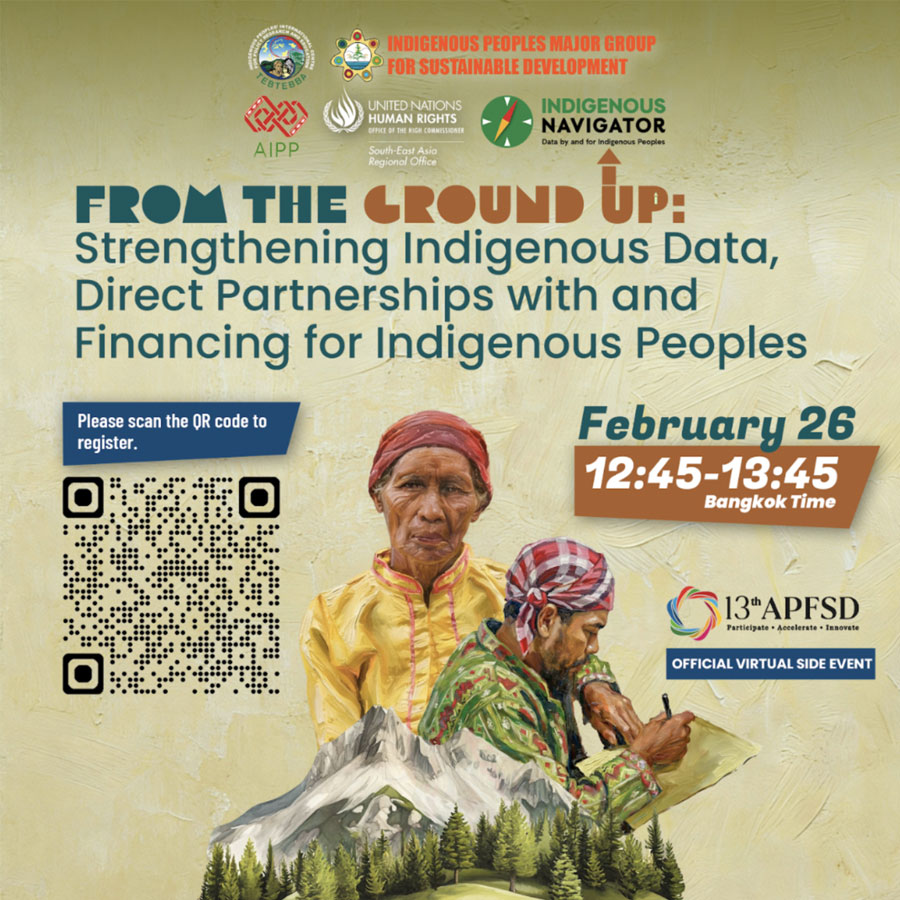

Co-organized by:
- Indigenous Peoples International Center for Policy Research and Education (Tebtebba)
- Indigenous Peoples Major Group for Sustainable Development (IPMG)
- Asia Indigenous Peoples Pact (AIPP)
- Indigenous Navigator Consortium
- Office of the High Commissioner on Human Rights-Bangkok (OHCHR)
- Right Energy Partnership with Indigenous Peoples (REP)